
Lobel's Culinary Club - Recipes, menu ideas, cooking techniques, meat selection tips, and more from America's #1 family of butchers.

Navigation

  • Categories
  • Archives
  • 175th anniversary
  • about lobel's
  • ask the butcher
  • autumn
  • bacon
  • barbecue
  • beef
  • braising
  • christmas
  • cinco de mayo
  • cooking tools
  • culinary classics
  • culinary diy
  • cut of the month
  • easter
  • entertaining
  • food history
  • food pairings
  • grilling
  • guide to meat
  • ham
  • hanukkah
  • holidays
  • lamb
  • lobel's prime meats in manhattan
  • new products
  • new year
  • passover
  • pork
  • poultry
  • recipes & techniques
  • recipes & techniques
  • roasting
  • sausage
  • seafood
  • seasons
  • smoking
  • social media
  • spring
  • stewing
  • summer
  • super sunday
  • thanksgiving
  • t-roy cooks
  • turkey
  • valentine's day
  • veal
  • videos
  • winter
  • yankee stadium
  • November 2021
  • April 2020
  • March 2020
  • February 2020
  • January 2020
  • December 2019
  • November 2019
  • October 2019
  • September 2019
  • April 2019
  • March 2019
  • September 2018
  • August 2018
  • July 2018
  • June 2018
  • May 2018
  • April 2018
  • March 2018
  • February 2018
  • January 2018
  • December 2017
  • November 2017
  • October 2017
  • September 2017
  • August 2017
  • July 2017
  • June 2017
  • May 2017
  • April 2017
  • March 2017
  • February 2017
  • January 2017
  • December 2016
  • November 2016
  • September 2016
  • August 2016
  • July 2016
  • June 2016
  • May 2016
  • April 2016
  • March 2016
  • February 2016
  • January 2016
  • November 2015
  • October 2015
  • September 2015
  • July 2015
  • June 2015
  • May 2015
  • April 2015
  • March 2015
  • February 2015
  • January 2015
  • December 2014
  • November 2014
  • October 2014
  • September 2014
  • August 2014
  • July 2014
  • June 2014
  • May 2014
  • April 2014
  • March 2014
  • February 2014
  • January 2014
  • December 2013
  • November 2013
  • October 2013
  • September 2013
  • August 2013
  • July 2013
  • June 2013
  • May 2013
  • April 2013
  • March 2013
  • February 2013
  • January 2013
  • November 2012
  • October 2012
  • September 2012
  • August 2012
  • July 2012
  • June 2012
  • May 2012
  • April 2012
  • March 2012
  • February 2012
  • January 2012
  • December 2011
  • November 2011
  • October 2011
  • September 2011
  • August 2011
  • July 2011
  • June 2011
  • May 2011
  • April 2011

Links

  • Lobels.com
  • Lobel’s Facebook
  • Lobel’s Pinterest
  • Lobel’s YouTube
  • Home
  • Welcome
  • Articles
  • Contact Us

Welcome

Welcome to the new Lobel’s Culinary Club.

In the years since we launched our Web site and online butcher shop, the Lobel’s Culinary Club has become the cornerstone of our communications with our customers old and new. Our e-mails span the latest news about products and promotions to help you plan peak dining experiences for family meals, special events, and casual entertaining.

A fundamental part of the Culinary Club content comes from our unique perspective as butchers on meat handling and preparation. And while there are many recipes to share, we want to help you go beyond specific recipes to a wider world of in-depth explorations of cooking techniques. When you understand the fundamentals, you are free to invent your own culinary masterpieces.

We believe the more you know about preparing the finest meat money can buy, the more you will enjoy serving it to your family and friends.

With the launch of our expanded Culinary Club, we’ve created a living archive of knowledge that is gleaned from past e-mails and will grow with future e-mails.

Within the Culinary Club, we hope you’ll find numerous and useful resources to enhance your confidence in preparing the finest and freshest meats available, and ensure your absolute delight with the results.

For your dining pleasure,

lobels Signature

Stanley, David, Mark, and Evan Lobel

Lobel Family at the Carving Station

Articles by Month:

  • November 2021
  • April 2020
  • March 2020
  • February 2020
  • January 2020
  • December 2019
  • November 2019
  • October 2019
  • September 2019
  • April 2019
  • March 2019
  • September 2018
  • August 2018
  • July 2018
  • June 2018
  • May 2018
  • April 2018
  • March 2018
  • February 2018
  • January 2018
  • December 2017
  • November 2017
  • October 2017
  • September 2017
  • August 2017
  • July 2017
  • June 2017
  • May 2017
  • April 2017
  • March 2017
  • February 2017
  • January 2017
  • December 2016
  • November 2016
  • September 2016
  • August 2016
  • July 2016
  • June 2016
  • May 2016
  • April 2016
  • March 2016
  • February 2016
  • January 2016
  • November 2015
  • October 2015
  • September 2015
  • July 2015
  • June 2015
  • May 2015
  • April 2015
  • March 2015
  • February 2015
  • January 2015
  • December 2014
  • November 2014
  • October 2014
  • September 2014
  • August 2014
  • July 2014
  • June 2014
  • May 2014
  • April 2014
  • March 2014
  • February 2014
  • January 2014
  • December 2013
  • November 2013
  • October 2013
  • September 2013
  • August 2013
  • July 2013
  • June 2013
  • May 2013
  • April 2013
  • March 2013
  • February 2013
  • January 2013
  • November 2012
  • October 2012
  • September 2012
  • August 2012
  • July 2012
  • June 2012
  • May 2012
  • April 2012
  • March 2012
  • February 2012
  • January 2012
  • December 2011
  • November 2011
  • October 2011
  • September 2011
  • August 2011
  • July 2011
  • June 2011
  • May 2011
  • April 2011

Articles by Subject:

  • 175th anniversary
  • about lobel's
  • ask the butcher
  • autumn
  • bacon
  • barbecue
  • beef
  • braising
  • christmas
  • cinco de mayo
  • cooking tools
  • culinary classics
  • culinary diy
  • cut of the month
  • easter
  • entertaining
  • food history
  • food pairings
  • grilling
  • guide to meat
  • ham
  • hanukkah
  • holidays
  • lamb
  • lobel's prime meats in manhattan
  • new products
  • new year
  • passover
  • pork
  • poultry
  • recipes & techniques
  • recipes & techniques
  • roasting
  • sausage
  • seafood
  • seasons
  • smoking
  • social media
  • spring
  • stewing
  • summer
  • super sunday
  • thanksgiving
  • t-roy cooks
  • turkey
  • valentine's day
  • veal
  • videos
  • winter
  • yankee stadium

Cut of the Month: St. Louis Ribs

On July 27,2015 In barbecue , cut of the month , pork

The Lobel family of Lobel’s Prime Meats in Manhattan and Lobel’s of New York online butcher shop are fourth- and fifth-generation butchers. With our Cut of the Month series, we will bring you their wealth of knowledge and expertise on specific cuts of meat, including their unique characteristics, preparation methods, and how to select the best cut.

Unlike Memphis, Kansas City, Texas, and the Carolinas, St. Louis, MO, is not often mentioned in the same breath when listing the capitals of American Southern-style barbecue. But it does lend its name to one of the primary types of pork ribs.
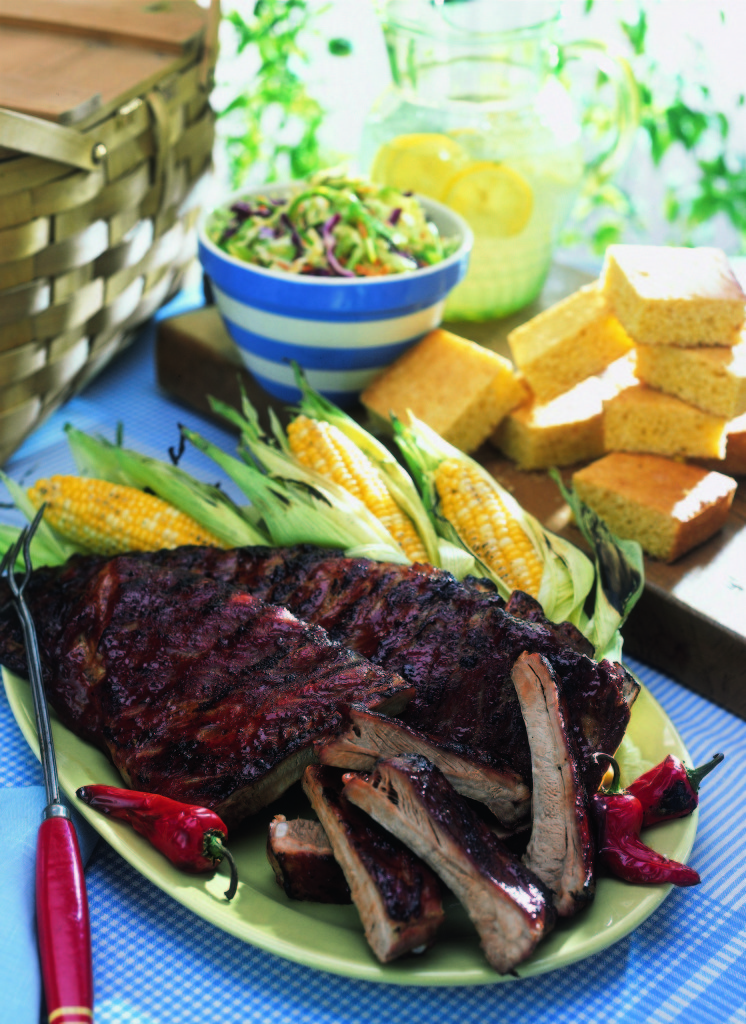
Pork - St Louis Pork Ribs


Why St. Louis gets short shrift in barbecue name recognition isn’t clear. St. Louis has a long tradition of distinctions that include some unique regional specialties.

Pork steak, for example, is a St. Louis phenomenon not found widely outside the lower Midwest. Pork steaks are bone-in slices of Boston butt, of the pig’s shoulder, which are seared on the grill and then simmered in a tomato-and-vinegar-based sauce.

Crispy snoots are pieces of pig snout and cheek that are smoked and/or grilled until crunchy, something akin to fried pork rind or chicharrón, and served as a sandwich or an appetizer.

St. Louis-Style Barbecue

By strict definition, barbecue is a style of cooking that is laid-back, low-and-slow, usually in the 225–250°F temperature range, and takes art and patience to render sumptuously smoky, tender delights from cantankerously tough cuts of meat. Grilling, on the other hand, is a more heat-aggressive style of cooking done at temperatures of 350°F or higher.

In truth, St. Louis barbecue is a bit of a misnomer because most is not done low-and-slow; rather grilling is the predominant method.

Another outstanding feature is St. Louis-style barbecue sauce, sort of a mash-up of Carolina and Kansas City styles of sauce. From the Carolinas, St. Louis sauce gets its relatively thin consistency, vinegar base, and mustard accents. From Kansas City, it gets its sweetness and tomato base.

St. Louis Ribs

So what makes a pork rib a St. Louis-style rib?

First, let’s take a look at ribs in general.

A hog’s rib bone runs from the sternum/belly to the spine.

  • Closest to the sternum are short lengths of cartilage called rib tips.
  • Moving toward the backbone, the next and longest section is the spare rib.
  • Connected to the backbone, baby back ribs are easily identifiable by their characteristic curved bone.
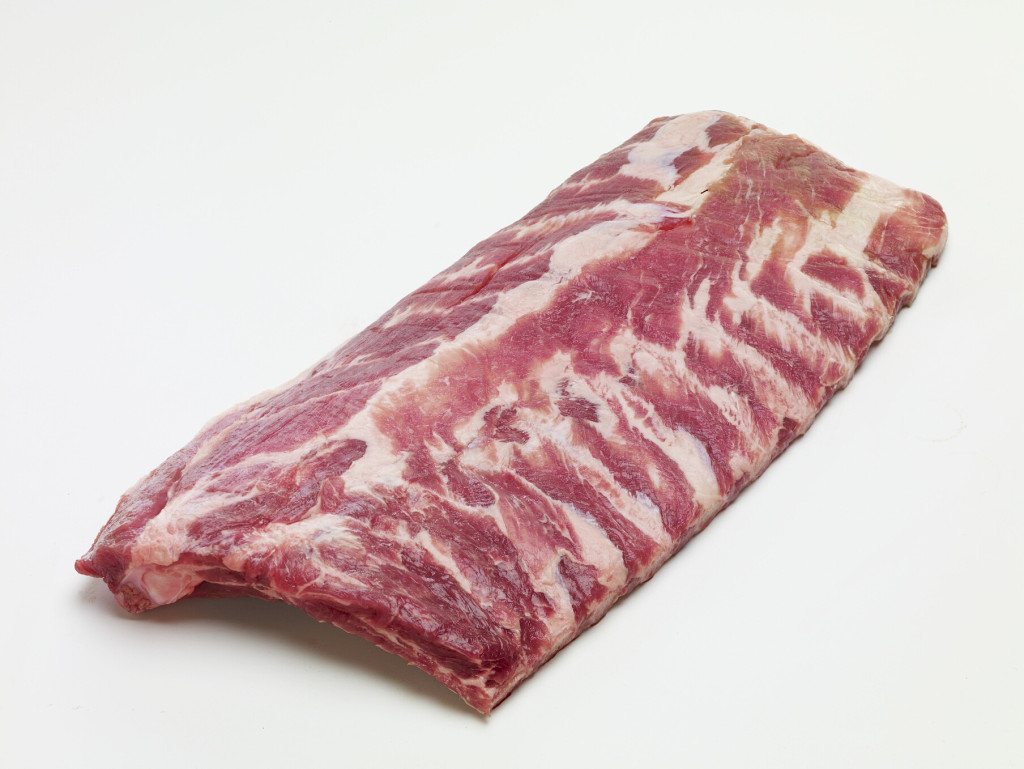
St. Louis Ribs

St. Louis ribs are a subsection of the spare rib in which the sternum, cartilage, and ribs tips have been removed. This type of butchering is preferred by many cooks because the result is a rectangular rack of 12–13 ribs that is even in size and shape from end to end. As a result, they are easier to barbecue, grill, or smoke for consistent and predictable results, unlike baby back ribs that are curved and shorter at one end and long and flat at the other.

St. Louis ribs are also preferred by many because of their meatiness as well as their marbling/fat content which renders during the cooking process to keep the ribs moist.

Like all rib sections, St. Louis ribs have a membrane on the underside. There is a long-standing debate about whether or not to remove that membrane before cooking. The no-membrane faction argues that the membrane is a barrier to the absorption of seasonings and smoke into the meat. The pro-membrane side of things claims that the membrane helps hold the rib together and doesn’t really affect flavor that much because the membrane is mostly covering bone.

If you want to remove the membrane, place the ribs meat-side down on a counter or cutting surface. Slide the tip of a sharp knife under one corner of the membrane and work the knife a bit to separate the membrane from the bone to create a “tab” of membrane that you simply pull away from the rib bones. Grabbing the tab with a paper towel will give you a sure grip when pulling.

Buying the Best St. Louis Ribs

Some hallmarks of a great quality St. Louis ribs are even, meaty coverage on the top side of the rack. Evenly distributed marbling will produce juicy ribs that baste themselves throughout the cooing process. However, avoid large areas of fat covering the meat.

As always, fresh is best. The color may vary with commodity pork being a light tan color to incredible Berkshire or heritage pork which will be a deep rosy pink.

Check the vacuum-sealed packaging for any seam breaks, tears, or any discoloration (greenish-bluish) or dry spots on the meat. Also, it is not uncommon for vacuum-sealed pork to have a slight odor when broken free of the confinement of the vacuum sealing. This is to be expected. The odor will dissipate in a few minutes once exposed to the air or rinsed with cold water. If the odor does not go away and is accompanied by discoloration, the ribs should not be consumed.

Cooking St. Louis Ribs

After far as cooking technique, the same procedures can be used for cooking St. Louis ribs as for baby-back ribs, except St. Louis needs a little more time.

For dry ribs, add a dry rub liberally on both sides of the rib rack and allow to rest for a couple of hours or overnight. Bring to room temperature before cooking.

If you want wet ribs, apply any sauce or glaze within the last half hour of cooking, especially if what you are adding has any sugar or other sweetener. Applying it at the right time will allow the glaze or sauce to caramelize to crispy, delicious perfection. Apply it too early and the sugars will burn and turn bitter.

Checking for Doneness

While an internal temperature of between 180–190°F is the preferred doneness range, getting an accurate reading on a rack of ribs is not easy. The rule of thumb is to check the temperature away from the bone, which conducts heat readily. The problem is that there really isn’t anywhere on a rack of ribs that is not right on top of the bone.
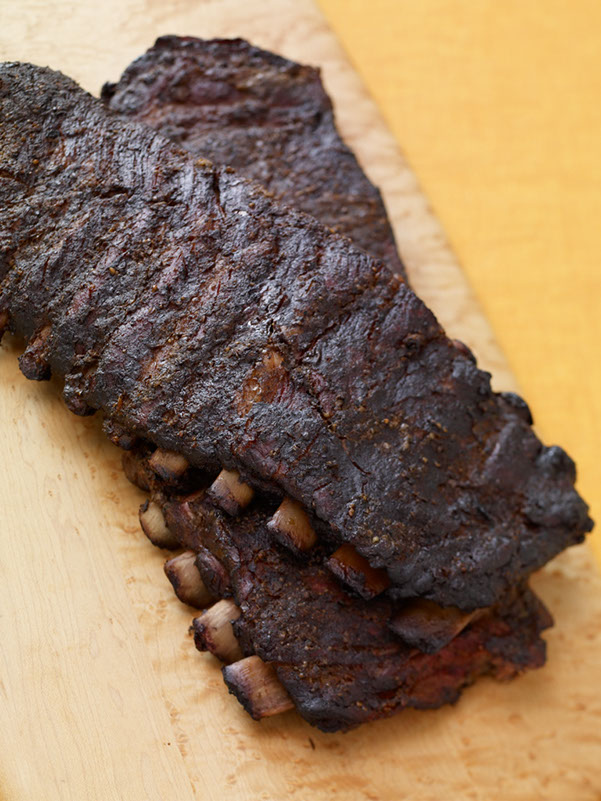
Pork - BBQ - Ribs

Therefore, the checkpoints for doneness with ribs are when the meat shrinks back from the bone and the tip of the rib protrudes about a ¼ to ½ inch. The second indicator is when you lift a rack of ribs turning the underside up. The rack should relax and crack a bit without falling off completely.

Recipes and Videos

Click this link for a handful of rib recipes. Even though they specify baby back ribs, St. Louis ribs can be easily substituted with some additional timing.

Or watch as our friend Troy of T-Roy Cooks demonstrates his technique with St. Louis ribs.

Do you prefer St. Louis or baby back ribs? Are you a dry ribs or a wet ribs sort of person? Do you prefer to oven-roast, grill, barbecue, or smoke your ribs? What’s your favorite sauce, glaze, or dry rub.

Leave Your Response

* *

© Copyright 2018
Lobel's Culinary Club.
All Rights Reserved

Lobel's of New York