

You’d be hard pressed to find a breakfast dish more decadent than Eggs Benedict.
It’s the kind of dish that is food for the psyche and soul. It is the elegant pinnacle of comfort food, an ode to excess. If you’re looking for a healthy blast of protein and carbs to get your day started, make a beeline for yogurt and an egg-white sandwich. Eggs Benedict, and its infinite variations, is all about indulgence—throwing caution to the wind for an almost divine interaction with your food. It’s petit déjeuner for a lazy day.
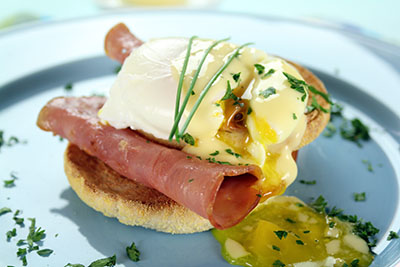
At the heart of this sumptuous repast—and the key to its richness—is the blending of butter and egg yolks, which are used in two different ways: as the foundation for the traditional Hollandaise sauce topping, and in the runny soft-poached eggs that ooze and mingle with the creamy sauce.
Which Came First?
So where did this delicious dish originate?
As with many classic dishes, there’s no real consensus on who made it first, where, or when. In this case, however, the stories lead inevitably to someone with the surname of Benedict.
The earliest claim goes back to 1894 and Wall Street broker, Lemuel Benedict, who is said to have ordered toast, poached eggs, bacon, and Hollandaise at the Waldorf Astoria in New York City as a cure for a nasty hangover. Subsequently, Waldorf maitre d’hotel, Oscar Tschirky, decided to add it to the hotel’s lunch and dinner menu with a couple of substitutions: a toasted English muffin for the toasted bread and ham for the bacon.
Another claim also goes to the turn of the century to Commodore Elias Cornelius Benedict, noted yachtsman and New York banker. According to a 1967 letter from Edward P. Montgomery, an American living in France, to New York Times food writer, Craig Claiborne, a recipe for the dish was passed on directly from the commodore to a friend who passed it on to Montgomery’s mother.
However, that wasn’t the last word on that particular legacy. After Claiborne’s column appeared in the New York Times Magazine, Mabel C. Butler from Massachusetts offered the claim that Mrs. Le Grand Benedict, who dined weekly with her husband at Delmonico’s restaurant in New York City, once asked the maitre d’hotel if he would suggest “something new or different.” In turn, he asked Mrs. Benedict if she had a preference. She responded by ordering poached eggs, English muffins, ham, and Hollandaise, topped with a truffle.
Hollandaise Sauce: The Nap of Luxury
Today, the default components of Eggs Benedict are, from bottom to top: Toasted English muffin, Canadian (loin) bacon, poached eggs, and Hollandaise sauce. To make a great Eggs Benedict, each component should be the best quality available. But without a doubt, what separates the real thing from the Benedict wannabes is the Hollandaise.
Hollandaise is one of the five French Mother Sauces, as codified by the king of chefs, Auguste Escoffier in the late 19th century. Most every sauce variation in French cuisine can be traced back to one of these five: Bechamel (white, roux-based sauce), Espagnole (brown, stock-based sauce), Veloute (white, stock-based sauce), Tomato, and Hollandaise. Hollandaise is said to have been created by a French chef in honor of a visit to France by the king of the Netherlands.
In terms of structure, Hollandaise is cousin to mayonnaise. Both are emulsions that include egg yolks, a touch of lemon juice, and a liquid fat. In the case of Hollandaise, that fat is melted butter in a warm sauce, whereas mayonnaise incorporates oil in a cold sauce. Famous variations on the basic Hollandaise include the classic sauce for steak, Sauce Béarnaise, which is Hollandaise with herbs, most prominently, tarragon. Sauce Mousseline, also known as Chantilly Cream, folds whipped cream into the Hollandaise for a heavenly light and rich sauce.
Hollandaise is a delicate sauce that requires a gentle hand and gentle heat, lest the sauce break, or separate, in the pan or turn into buttery scrambled egg yolks. Consequently, it is typically made in a double boiler, or bain marie.
(Kitchen Hint: Butter-based sauces from Hollandaise to butter cream can be salvaged if they break by whisking in some cold, heavy cream a tablespoon at a time until the sauce reconstitutes itself.)
Myriad Variations
If you want to go off the chart with your own variation, try adding Cajun or Creole spices to the basic Hollandaise recipe. Or add garam masala for the taste of curry, Chinese 5-spice powder, pesto, chimichurri, salsa—whatever springs into your imagination.
And while an English muffin may be traditional, don’t be afraid to shake things up and use toasted bread of any flavor or texture: bagel, flat bread, pita, or toasted corn bread. It’s all up to you, your appetite, and what’s in your pantry.
Similarly, another way to distinguish your own Benedict variation is to change up the meat, seafood, or vegetables that go between the muffin and the egg. Sausage patties or links; ham and its myriad related cured, smoked, or grilled meats; shrimp or lobster; and sautéed veggies are all prime candidates.
In the category of “Nothing succeeds like excess,” try substituting a slice of foie gras for the bacon and top it all with a truffle-flecked Hollandaise and a crowning dollop of caviar.
At the other end of the spectrum is the hand-held, fast-food counterpart: McDonald’s Egg McMuffin which substitutes a slice of American cheese for the Hollandaise.
Here are some tempting Benedict variations to whet your appetite. In the variations below, unless otherwise noted, each assumes the use of poached eggs, English muffins, and Hollandaise sauce.
Eggs Michael: 2 poached eggs over an English muffin with ham, mushrooms, and cheddar cheese topped with hollandaise sauce.
Eggs Michelle: 2 poached eggs over an English muffin with Swiss cheese and mushrooms topped with hollandaise sauce.
Lox Benedict (or Norwegian Eggs): 2 poached eggs over an English muffin with lox topped with hollandaise sauce.
Eggs Florentine: 2 poached eggs over an English muffin with spinach topped with hollandaise sauce.
Eggs Alaska: 2 poached eggs over an English muffin with crab meat topped with hollandaise sauce.
Eggs Enchilada: 2 poached eggs over toasted pita bread with chili and cheddar cheese.
Eggs California: 2 poached eggs over an English muffin with spinach, avocado, and heirloom tomatoes topped with hollandaise sauce.
Eggs Maryland: 2 poached eggs over crab cakes topped with hollandaise sauce.
Waldorf Style Eggs: 2 poached eggs over toast with bacon, sautéed mushrooms, and mushroom sauce.
Eggs Sardou: A Creole version, 2 poached eggs over artichokes and anchovy filets topped with Hollandaise, diced ham, and a truffle slice.
Artichoke Eggs: 2 poached eggs over cooked artichoke hearts with Canadian bacon topped with hollandaise sauce.
Eggs Blackstone: 2 poached eggs over an English muffin with streaky (strip) bacon and tomato topped with hollandaise sauce.
Asparagus Eggs: 2 poached eggs over an English muffin with asparagus spears topped with hollandaise sauce.
Country Eggs Benedict: 2 poached eggs over an English muffin with sausage slices topped with sausage gravy.
What word do you usually use to describe Eggs Benedict: delicious, decadent, luxurious, incredible, mmmmmmm? What’s the most incredible Eggs Benedict you’ve ever had? What’s your favorite variation? Inspired to makes Eggs Benedict this weekend? Which variation will be on your breakfast table next?

Leave Your Response